Energy Transfer (ET)·Q4 2025 Earnings Summary
Energy Transfer Beats on EBITDA as Data Center Demand Drives Record Volumes
February 17, 2026 · by Fintool AI Agent
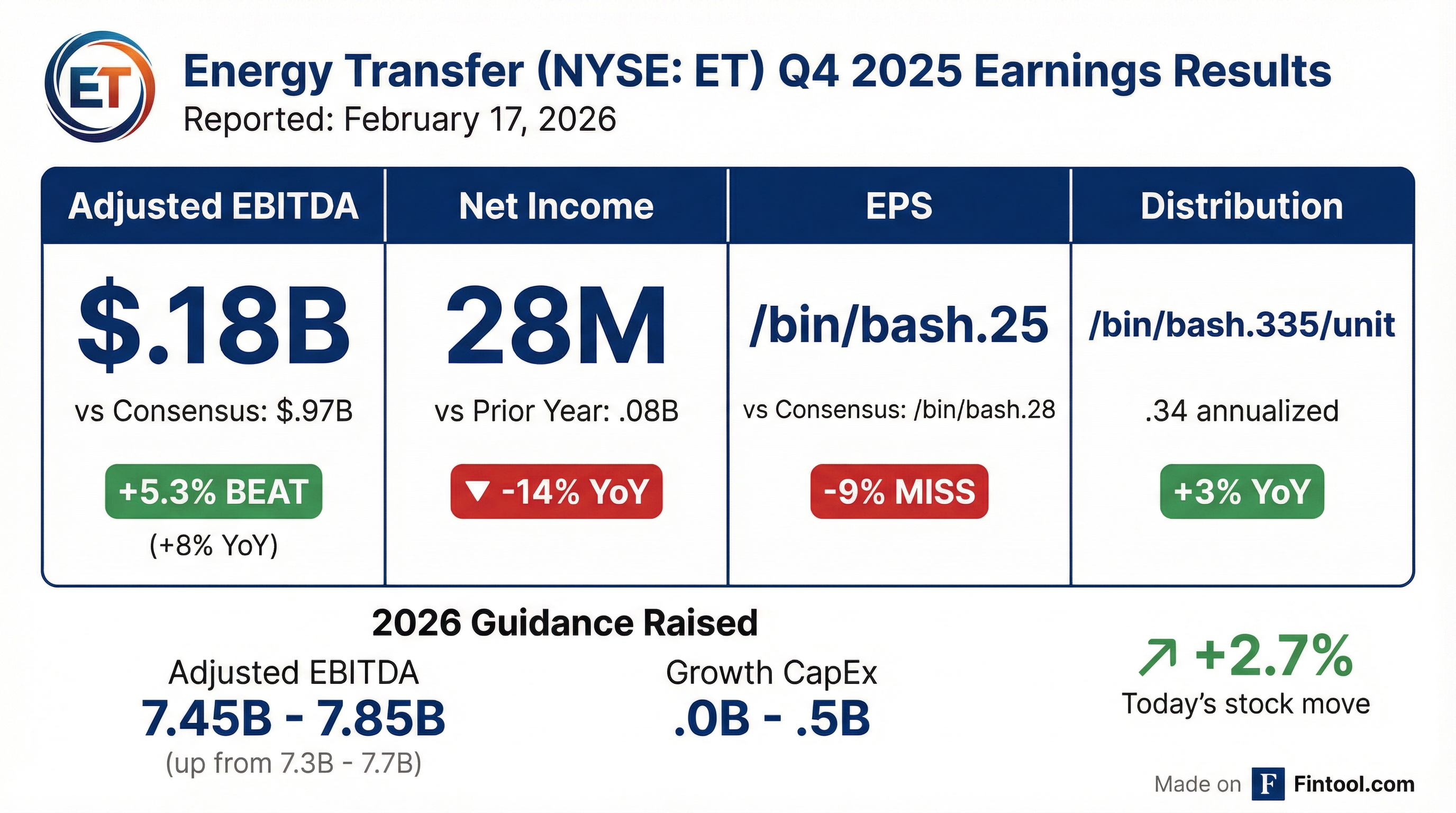
Energy Transfer delivered a mixed Q4 2025, beating Adjusted EBITDA consensus by 5.3% while missing EPS estimates due to impairment charges and lower net income versus the prior year. The midstream giant reported record volumes across multiple segments, raised 2026 guidance, and highlighted growing exposure to data center demand through its Oracle contracts.
Did Energy Transfer Beat Earnings?
Adjusted EBITDA: Beat by 5.3% — Energy Transfer reported Q4 2025 Adjusted EBITDA of approximately $4.2 billion versus consensus of $3.97 billion, an 8% increase year-over-year from approximately $3.9 billion in Q4 2024.
EPS: Missed by 9.4% — Net income per common unit (basic) was $0.25 versus consensus of $0.28. Net income attributable to partners declined 14% to $928 million from $1.08 billion in Q4 2024, primarily due to $277 million in impairment losses and higher interest expense.
Full Year 2025 — Adjusted EBITDA was nearly $16 billion (+3% YoY), a partnership record, while Distributable Cash Flow was $8.2 billion, essentially flat with 2024. The partnership moved record volumes across interstate, midstream, NGL, and crude segments for the year.
One-Time Items Impact — CFO Dylan Bramhall provided color on non-recurring items affecting Q4: In the NGL segment, a $56M benefit from a regulatory order was offset by $58M of unfavorable hedge timing and $14M from fog delays at Nederland (both expected to recoup in Q1). Crude benefited from $19M of the regulatory order, while Midstream saw a $14M intersegment fee increase and $20M from producer shut-ins due to negative Waha pricing. Corporate absorbed $60M in Parkland transaction expenses. Net impact: approximately -$90M, with $70M+ expected to recover in Q1 2026.
 Ask Fintool AI Agent
What Did Management Guide?
Energy Transfer raised 2026 Adjusted EBITDA guidance to $17.45-$17.85 billion, up from the prior range of $17.3-$17.7 billion. The increase is solely attributable to USA Compression's acquisition of J-W Power Company, which closed on January 12, 2026.
Growth capital expenditures for 2026 remain at $5.0-$5.5 billion, excluding Sun and USA Compression. Approximately two-thirds of this capital will be invested in natural gas assets including Hugh Brinson, Desert Southwest, Mustang Draw 1 and 2, and continued Permian build-out. About one quarter will go toward NGL and refined products (Nederland and Marcus Hook terminal expansions, Frac IX).
Management continues to target a long-term annual distribution growth rate of 3%-5% and expects to maintain leverage of 4-4.5x EBITDA during this period of elevated investment.
How Did the Stock React?
ET shares rose 2.7% on the day, trading at $18.75 versus a prior close of $18.26. The stock is up 29% from its 52-week low of $14.60 but remains 9% below its 52-week high of $20.51.*
What Changed From Last Quarter?
Volume records across segments — Q4 2025 saw partnership records in NGL fractionation volumes (+3% YoY) and crude oil transportation volumes (+6% YoY). NGL and refined product terminal volumes jumped 12%, with NGL transportation up 5% and NGL exports up 12%.
Lake Charles LNG suspended — Energy Transfer suspended development of the Lake Charles LNG export project in December 2025 to focus capital on natural gas pipeline infrastructure projects that management believes offer superior risk/return profiles.
Desert Southwest expansion upsized — The Transwestern Pipeline expansion increased from 42-inch to 48-inch diameter, boosting capacity to 2.3 Bcf/d (up from 1.5 Bcf/d) and estimated cost to ~$5.6 billion. The project remains supported by long-term contracts serving Arizona and New Mexico growth.
Data center momentum — ET recently began flowing gas on the first pipeline lateral to Oracle's data center campus near Abilene, Texas. Two more laterals are expected to be completed by mid-2026, with supply sourced from Hugh Brinson and North Texas pipelines. Within the last year, ET has contracted over 6 Bcf/d of pipeline capacity with demand-pull customers including end users, data centers, and utilities.
Hugh Brinson construction update — As of the call, 100% of the 42-inch pipe has been delivered to pipe yards and mainline construction is approximately 75% complete. Phase one remains on track for Q4 2025 in-service, with potential for early volumes prior to formal commissioning. Phase two expected Q1 2027.
Ask Fintool AI AgentWhat Did Management Say?
Mackie McCrea emphasized the strategic positioning of ET's integrated asset base:
"Listening to Tom go through that opening statement, it's hard to not get overly excited... We couldn't be more excited about the future with our DSW project, a 500-mile, 48-inch pipeline, largest pipeline ever built in the U.S. as far as that distance with the 48."
On data center and power demand:
"We're chasing every opportunity to provide gas or natural gas-fired generation for data centers. We're well positioned with all of our pipelines. We're talking to 150+ different opportunities, and it seems like a new one or two come in every day."
On competitive advantage in natural gas supply:
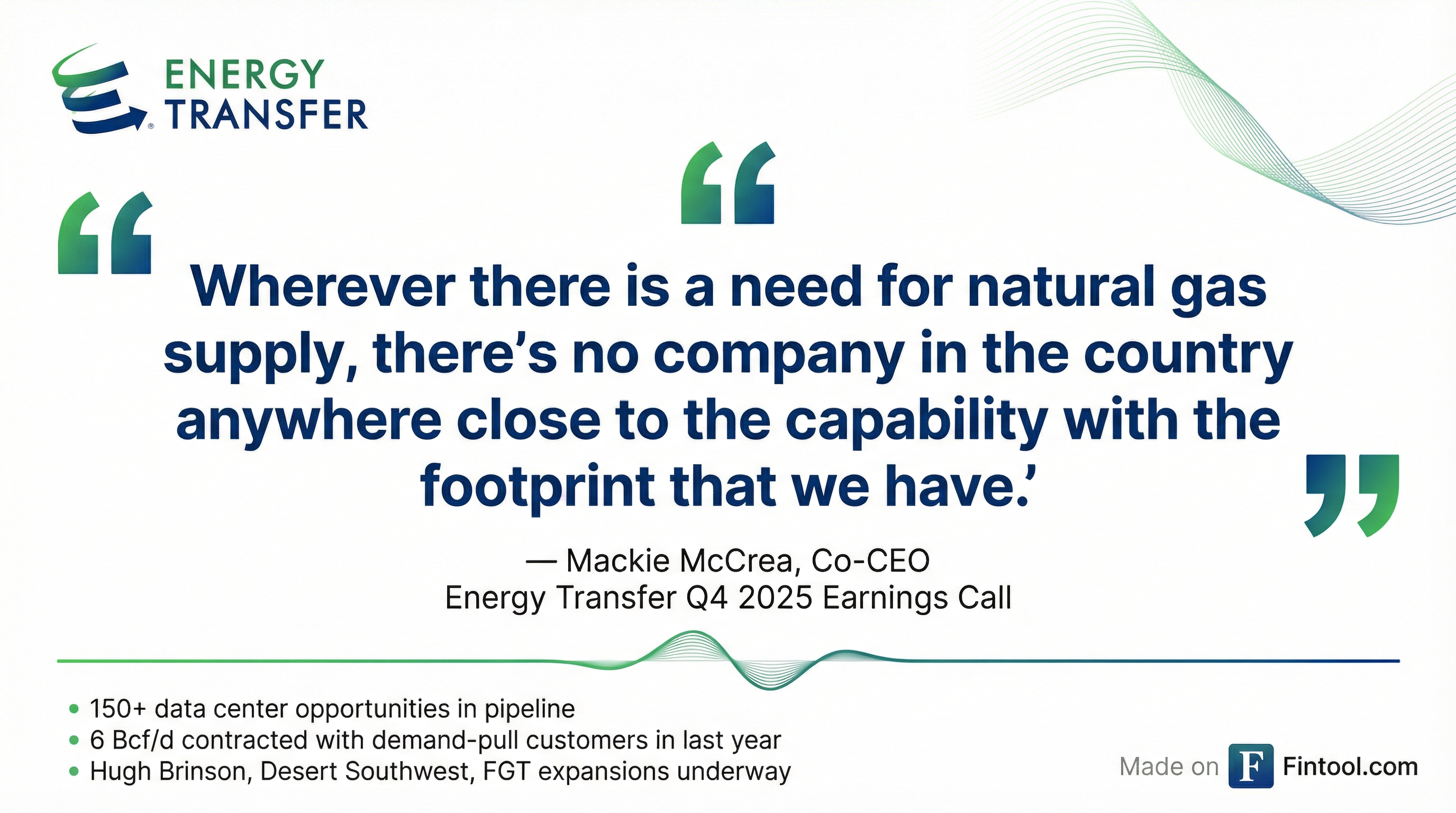
"Wherever there is a need for natural gas supply, there's no company in the country anywhere close to the capability with the footprint that we have... We can upsize, loop, add compression, and provide whatever natural gas needs that anybody has along our systems."
On winter storm performance:
"In tough times, we proved ourselves during Uri, paid off in a big way. Same way, this last storm that came in in January, we were prepared as good as we could be... We didn't see the type of profits and earnings that we saw a number of years ago with Uri, but as we always do, our team performed excellently."
Q&A Highlights
On Hugh Brinson Early Volumes (Jean Ann Salisbury, Bank of America)
Management confirmed potential for early volumes before Q4 formal in-service: "We are moving very well ahead of schedule on Hugh Brinson... At this point, we are confident that we will be able to bring on some volumes earlier than the fourth quarter." The timing is important given competing pipeline delays.
On Desert Southwest Economics (Julian Dumoulin-Smith, Jefferies)
Mackie McCrea on DSW returns: "We don't wanna over-exaggerate the expectations, but right now, that type of project, that size... we think that'll be probably one of the better rate of return projects that we've ever built just as far as a one-way flow." He noted Arizona/New Mexico markets are discussing 25-35 GW of power growth demand.
On Multi-Year Growth Trajectory (Keith Stanley, Wolfe)
CFO Dylan Bramhall explained the framework: "When we set our long-term distribution growth rate of 3%-5% annually, that was very strategically set. That's not meant to be a manufactured growth rate that's really driven from eating into coverage. When we set that, that basically sets the floor for what we believe we can achieve for our long-term growth rate."
On NGL Volume Mix (Theresa Chen, Barclays)
Management disclosed that approximately 60% of NGL volumes come from ET's own facilities, with 40% from third parties. That affiliate percentage continues to grow as new Permian processing plants (Mustang Draw 1 and 2) come online, adding 85,000-90,000 barrels per day.
On Waha Exposure (Michael Blum, Wells Fargo)
ET has approximately 160,000 Mcf/d of open capacity to capture Waha spreads on a day-to-day basis. Much of their previous open position was contracted to support Hugh Brinson and other projects.
On Lake Charles Alternatives (John McKay, Goldman Sachs)
With the LNG project suspended, management is evaluating alternative uses: "There's no limit to what we're looking at. We're looking at, it could be NGLs, it could be a crude oil terminal, it could be accommodate other commodities... that is such a great location."
On Power Plant Opportunities Beyond Data Centers (Mackie McCrea)
Beyond data center deals, the Oklahoma team added connections to serve three new power plants totaling 190 MMcf/d expected online Q2 2026, with another 350 MMcf/d in advanced negotiations. "To the best of my knowledge, I don't think any of that's data centers. It's all just for population growth and new manufacturing growth."
On FGT Florida Expansion (Mackie McCrea)
FGT Phase IX open season had more interest than the 550 MMcf/d capacity offered: "We anticipate in the future we'll have another expansion off Florida. That's a pipeline that just keeps giving."
How Did Segments Perform?
Intrastate Transportation (+35% YoY) — Segment EBITDA rose to $355M from $263M driven by increased pipeline and storage optimization, as well as increased volumes across the Texas intrastate pipeline system due to third-party volume growth.
Interstate Transportation (+6% YoY) — EBITDA increased to $523M from $493M primarily due to more capacity sold and higher utilization on Panhandle Eastern, Trunkline, Florida Gas, and Transwestern pipelines.
Midstream (+2% YoY) — Segment EBITDA of $720M (vs $705M) was primarily due to volume growth in the Permian, Northeast, and Ark-La-Tex regions, partially offset by a one-time $14M intersegment NGL transportation fee increase from the regulatory order.
NGL & Refined Products (flat YoY) — EBITDA was approximately $1.1B, consistent with Q4 2024. Higher throughput across Gulf Coast and Mariner East pipelines, Mont Belvieu fractionators, and Nederland Terminal was offset by $58M of lower gains from NGL hedge timing (expected to recover in Q1) and $14M from fog-related loading delays at Nederland. A one-time $56M benefit from a regulatory order impacting prior/current period rates provided partial offset.
Crude Oil (-5% YoY) — Segment EBITDA fell to $722M from $760M. Growth across several crude pipeline systems and the Permian Basin gathering system was offset by lower transportation revenues on the Bakken Pipeline. Results included a $19M one-time benefit from the regulatory order.
Sunoco LP (+47% YoY) — EBITDA surged to $646M from $439M driven by the Parkland acquisition and favorable transmix/blending margins.
What Are the Key Growth Projects?
Balance Sheet & Capital Allocation
As of December 31, 2025, Energy Transfer had $2.12 billion of available borrowing capacity on its $5.0 billion revolving credit facility.
Total debt increased to $68.3 billion from $59.8 billion at year-end 2024, reflecting the Parkland acquisition financing and growth capital investments.
Management remains committed to maintaining leverage of 4.0-4.5x EBITDA as calculated by the rating agencies during this elevated growth capex period.
Ask Fintool AI AgentForward Catalysts
-
Hugh Brinson early volumes — With construction 75% complete and potential for early volumes before Q4, any Waha basis relief would benefit ET and Permian producers.
-
Data center pipeline expansion — Management is pursuing 150+ data center opportunities with "a new one or two coming in every day." Oracle deliveries ramping, with two more laterals expected by mid-2026.
-
Permian processing — Mustang Draw 1 (Q2 2026) and Mustang Draw 2 (Q4 2026) will add 550 MMcf/d combined, generating 85,000-90,000 barrels per day of NGL equity volumes.
-
Oklahoma power plant connections — 190 MMcf/d coming online Q2 2026 with 350 MMcf/d more in advanced negotiations, all under long-term contracts with investment-grade counterparties.
-
DAPL Canadian crude FID — Decision expected by mid-2026 on 250,000 bpd light Canadian crude project with Enbridge, potentially unlocking new revenue stream.
-
FGT Phase X potential — Florida Gas Phase IX open season generated more demand than the 550 MMcf/d offered, suggesting a Phase X expansion is likely.
Key Risks
- Execution risk — $5+ billion annual growth capex requires successful project delivery
- Leverage — Net debt increased meaningfully; maintaining investment grade ratings is critical
- Commodity exposure — While largely fee-based (~40% from natural gas assets), some segments have commodity sensitivity
- Regulatory — Large pipeline projects face permitting and environmental challenges
*Stock price data from S&P Global. Estimates consensus from S&P Global Capital IQ.
Related: Energy Transfer Company Profile | Q3 2025 Earnings Call Transcript | View Q4 2025 8-K Filing